
Spectrum analyzers are essential instruments in electronics, telecommunications, and radio frequency (RF) engineering. They help engineers examine signals across different frequencies, identify unwanted emissions, measure signal strength, and investigate interference. As Malaysia continues to develop its electronics manufacturing, telecommunications, semiconductor, and technology sectors, reliable measurement equipment plays an important role in product development and quality assurance.
For engineering laboratories, research institutions, manufacturers, and technical service providers, choosing suitable spectrum analyzers can improve measurement accuracy and make testing workflows more efficient. Understanding their functions, specifications, and applications helps organizations select equipment that matches their technical requirements.
Understanding How Spectrum Analyzers Work
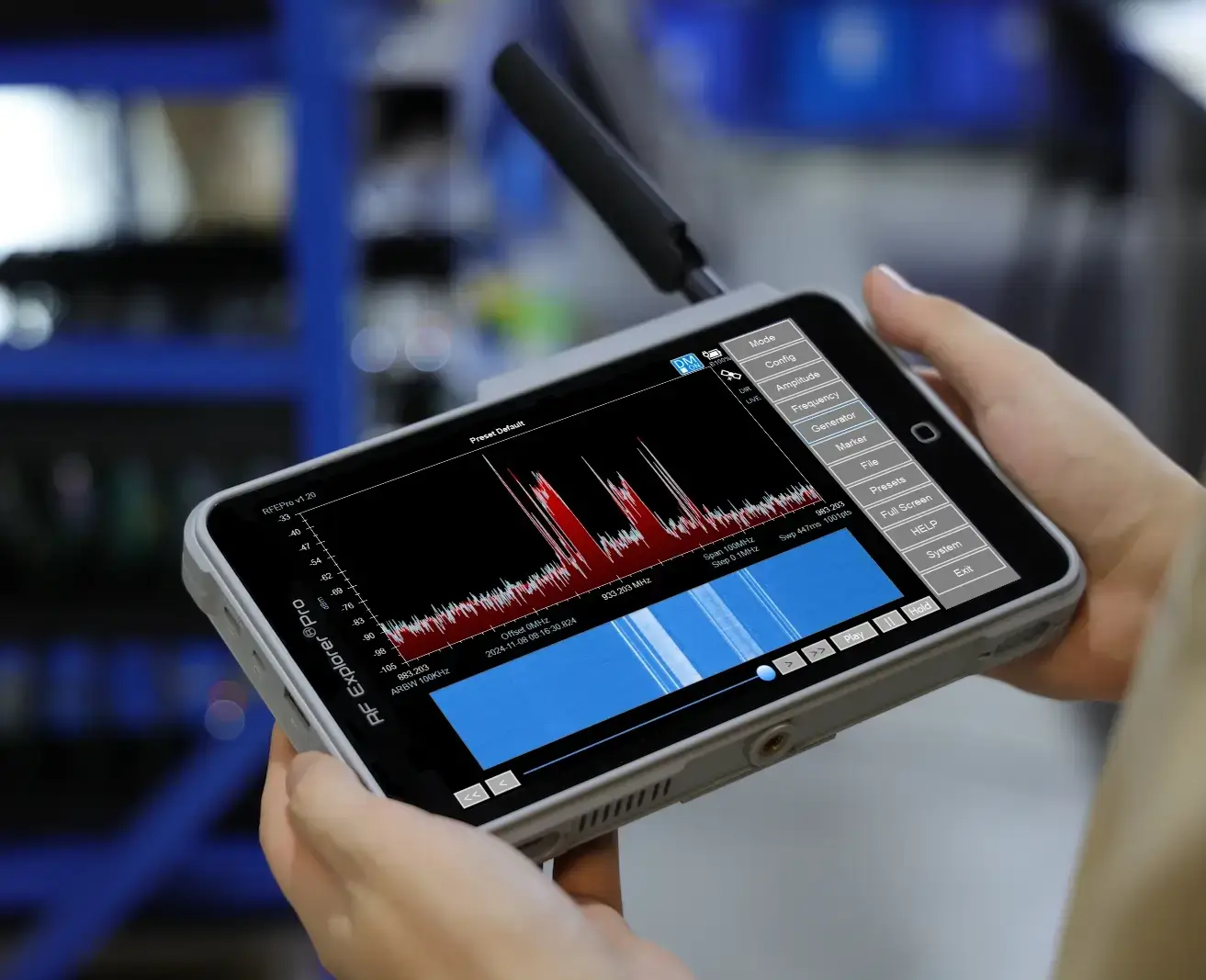
A spectrum analyzer measures the amplitude of electrical signals across a range of frequencies. Unlike an oscilloscope, which primarily displays how a signal changes over time, a spectrum analyzer presents signal information in the frequency domain.
Its horizontal axis represents frequency, while its vertical axis represents signal amplitude, commonly measured in dBm. This display allows engineers to identify fundamental signals, harmonics, unwanted emissions, and other frequency-related characteristics.
For example, an engineer testing a wireless communication device can use a spectrum analyzer to examine its transmitted signal and identify unexpected frequency components. The instrument can also help investigate interference that affects communication performance.
Different analyzer architectures and technologies are available. Traditional swept-tuned analyzers examine frequency ranges sequentially, while real-time spectrum analyzers can capture and analyze changing signals over a defined observation bandwidth. The appropriate technology depends on the signal characteristics and testing objectives.
Applications Across Malaysian Industries
Spectrum analyzers support a broad range of technical applications in Malaysia. Their ability to examine RF signals makes them useful in several industries.
Telecommunications: Engineers use spectrum analysis to investigate wireless signals, examine frequency occupancy, and troubleshoot interference. Telecommunications testing can involve cellular equipment, wireless networks, antennas, and radio transmission systems.
Electronics manufacturing: Manufacturers use spectrum analyzers during product development and quality assurance. They help engineers evaluate RF modules, communication devices, electronic assemblies, and other products that generate or receive high-frequency signals.
Research and development: Universities, engineering laboratories, and research organizations use these instruments to study signal behavior, develop electronic circuits, and validate new technologies.
Aerospace and automotive electronics: RF measurement equipment can support testing of communication systems, radar-related components, wireless sensors, and electronic subsystems.
Broadcasting and wireless services: Spectrum analyzers help technical teams examine signal characteristics and investigate unwanted emissions or interference affecting radio-frequency systems.
These applications demonstrate why accurate frequency-domain measurements are important for organizations working with modern electronic equipment.
Important Specifications to Consider
Selecting a spectrum analyzer requires more than comparing prices or choosing the instrument with the highest frequency range. Engineers should evaluate several specifications based on their intended measurements.
Frequency range: The frequency range determines which signals an instrument can analyze. Basic RF troubleshooting may require a different range from microwave research or advanced wireless testing. Buyers should consider both current requirements and possible future applications.
Resolution bandwidth: Resolution bandwidth, or RBW, affects the instrument’s ability to distinguish signals that are close together in frequency. Narrower bandwidth settings can help separate closely spaced signals, although they may increase measurement time.
Displayed average noise level: The displayed average noise level, or DANL, indicates the analyzer’s ability to detect low-level signals. A lower noise floor is valuable when measuring weak signals near stronger background noise.
Phase noise: Phase noise describes short-term fluctuations in a signal’s phase. It is particularly important when evaluating oscillators, frequency sources, and communication systems that require precise frequency performance.
Amplitude accuracy: Reliable amplitude measurements are essential when checking signal levels, comparing test results, or validating electronic products.
Analysis bandwidth: For applications involving rapidly changing or wideband signals, analysis bandwidth determines how much frequency information can be captured and examined at one time.
Reviewing these specifications helps engineers identify equipment that is suitable for their measurement tasks.
Bench and Handheld Spectrum Analyzers
Spectrum analyzers are available in different physical configurations, with benchtop and handheld instruments being two common options.
Benchtop spectrum analyzers are designed for laboratory environments, production facilities, and research applications. They generally provide larger displays, extensive measurement controls, and options for automated testing. These instruments are useful when measurements require detailed analysis and repeatable test procedures.
Handheld spectrum analyzers are designed for portability. They can be useful for field engineers investigating RF signals, checking wireless installations, and troubleshooting equipment at different locations.
The choice depends on the working environment. A laboratory performing detailed product characterization may prioritize advanced analysis capabilities, while a field service team may value portability, battery operation, and convenient measurements.
Spectrum Analyzer Options Available in Malaysia
Organizations looking for spectrum analyzers in Malaysia can explore equipment from several established test and measurement manufacturers. These include Keysight Technologies, Rohde & Schwarz, GW Instek, Tektronix, and other instrument suppliers.
For example, the Malaysian distributor ELSO Technologies lists Keysight instruments across several categories, including FieldFox handheld microwave spectrum analyzers, CXA signal analyzers, and basic spectrum analyzers. Its published product portfolio illustrates the range of equipment available for different RF measurement requirements.
Malaysian electronics distributors and test equipment retailers also list products from multiple manufacturers. Element14 Malaysia, for example, provides a spectrum analyzer category featuring brands such as Keysight, Rohde & Schwarz, and GW Instek. <Cite refs={[“turn131602search3″,”turn131602search0”]}/>
When evaluating a supplier, buyers should check product authenticity, manufacturer warranty, calibration documentation, technical support, and availability of accessories. It is also useful to confirm whether the supplier can assist with instrument configuration and application-specific questions.
The Role of Spectrum Analysis in Wireless Testing
Wireless technology continues to create new measurement requirements for electronics engineers. Devices operating in different frequency bands must meet applicable performance and regulatory requirements.
Spectrum analyzers help engineers examine signal bandwidth, unwanted emissions, harmonic content, and interference. They can also support investigations into unexpected signal behavior during product development.
For more advanced applications, engineers may need additional measurement capabilities, such as channel power analysis, adjacent-channel power measurements, occupied bandwidth measurements, and spectrogram displays. Availability depends on the instrument model and installed software options.
It is important to select measurement equipment based on the applicable test method rather than assuming that every spectrum analyzer provides identical functionality.
Improving Testing Efficiency with Modern Instruments
Modern spectrum analyzers often include software features and communication interfaces that support automated measurement workflows. Depending on the model, instruments may offer USB, LAN, or other remote-control options.
These capabilities allow engineers to integrate analyzers into computer-controlled test environments. Automated measurements can reduce repetitive manual operations and help teams collect consistent results across multiple devices.
Software integration is especially useful in production testing, where similar measurements may need to be performed repeatedly. Engineers can configure test sequences, record measurement results, and review performance data more efficiently.
Regular calibration and proper instrument maintenance are also important. Calibration helps verify measurement performance against defined standards, while suitable handling and operating conditions help maintain equipment reliability.
Choosing a Reliable Spectrum Analyzer Supplier
Purchasing a spectrum analyzer is an investment in measurement capability. Malaysian organizations should evaluate both the instrument and the support available from the supplier.
Important considerations include product availability, technical consultation, warranty coverage, calibration services, repair support, and access to replacement accessories. Buyers should also request detailed specifications and confirm that the selected model supports the required measurement functions.
Comparing several instruments using the same technical requirements can make the purchasing process more straightforward. A suitable analyzer should meet the application’s frequency range, sensitivity, bandwidth, accuracy, and operational requirements without unnecessary complexity.
Conclusion
Spectrum analyzers are valuable tools for engineers working in telecommunications, electronics manufacturing, research, wireless testing, and other technology-driven industries. They provide essential insight into signal behavior and help identify frequency-related problems that may not be visible through time-domain measurements alone.
For organizations exploring spectrum analyzers in Malaysia, understanding instrument specifications and application requirements is the first step toward making an informed selection. By evaluating frequency range, noise performance, resolution bandwidth, measurement features, and supplier support, engineering teams can choose equipment that supports dependable testing and long-term measurement needs.